The full recipe book + three years of meals, already calculated for your sugar glider family.
All 25 SGS2 recipes with step-by-step method, ingredients scaled to your colony (1-6 gliders), colour-coded calendar that tells you which box to thaw each day. You don't need the original book: everything is inside — common base, recipe-specific overrides, nutritional values, where to buy specialty ingredients. Each prep covers ~40 days. Plus printable bonus pack: freezer labels, pocket A6 shopping list, observation journal, quick reference.
Every 40 days, same story: cookbook, math, shopping list, missed ingredients.
You have 25 recipes in the SGS2 cookbook, a hand-drawn rotation table, and every time you cook a batch you have to: pick the 4 recipes for the period, sum the ingredients, scale them to your colony, write the shopping list.
It eats half an evening. And every other time, you forget something at the store. Then back home: which box do I thaw today? Where are the substitutions if I can't find papaya?
APPETAURI does all of it for you — once, for the next 3 years — and gives you the printable tools for everything else.
What's inside
📖 FULL RECIPE BOOK · self-contained
All 25 SGS2 recipes with the universal step-by-step method, common base, recipe-specific overrides, nutritional values for each, and where to buy specialty products (Wombaroo HPS, ground pollen, acacia, etc.). No need to own the original book: it's all in here.
📅 30 forty-day cycles × 4 recipes
3 years (2026 + 2027 + 2028) of ready meal plans, organised in forty-day cycles: cook once, thaw daily. 120 recipe windows total.
🛒 Shopping list per cycle
Ingredients aggregated for one prep = 40 days of food, automatically scaled to your colony (1, 2, 3, 4, 5 or 6 gliders).
🎨 Daily-rotation calendar
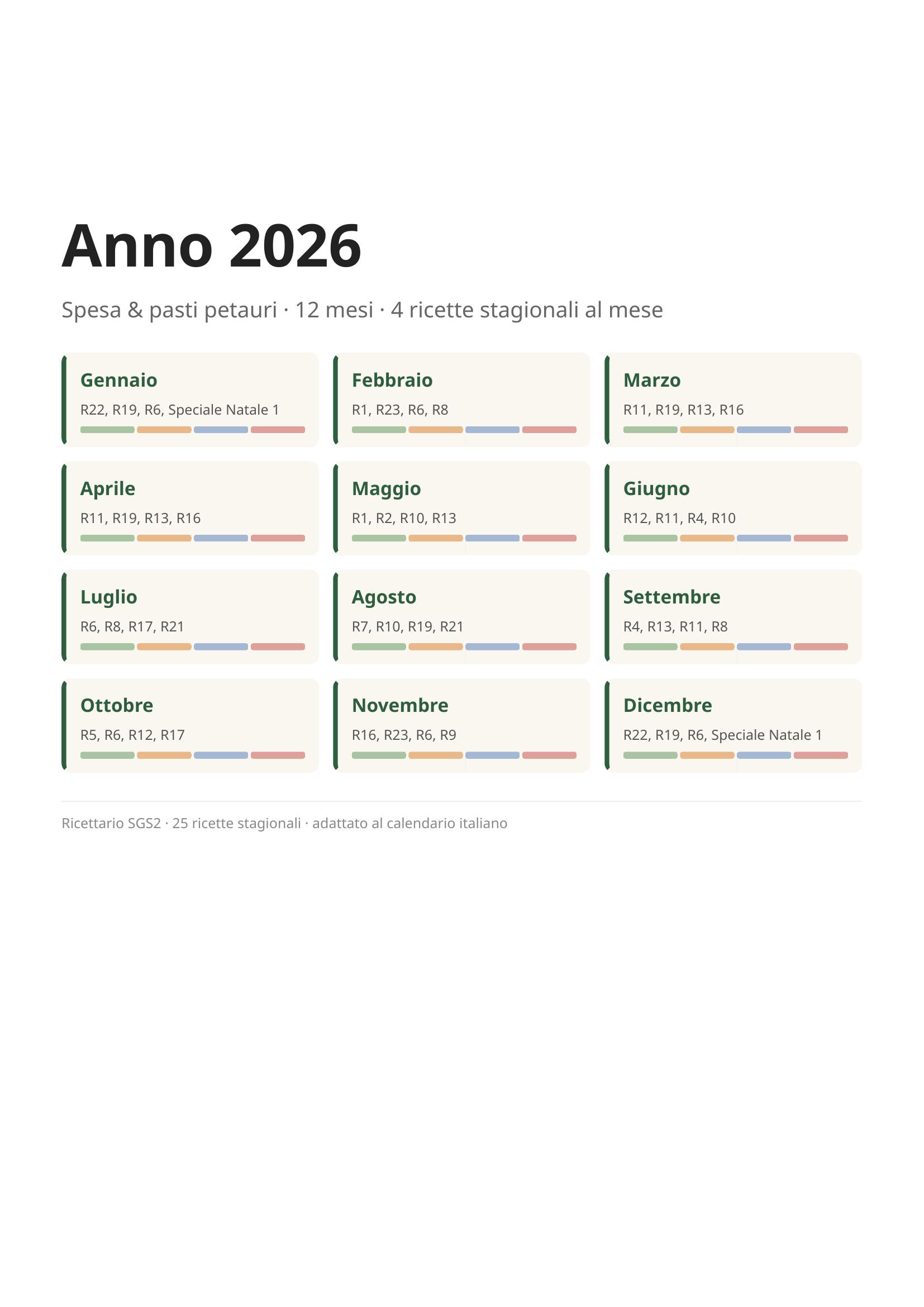
4 colour bands (green, orange, blue, pink). The recipes rotate one day each — scientific rationale in the Science section.
🥄 Base ingredients summed
HPS, flaxseed, pollen, yogurt, calcium+magnesium, eggs: already in the right quantities for the entire cycle.
🏷️ BONUS · Printable freezer labels
30 ready-to-cut pages: one label per daily dose (1,200 labels across 3 years), with colour-coded R#, recipe name, consumption date, and weekday.
📋 BONUS · Pocket A6 shopping list
Each cycle's shopping list in portable A6 format with checkboxes. Print one A4, fold in half: the perfect grocery store list.
📝 BONUS · Monthly observation journal
36 printable pages (one per month × 3 years): weekly weight grid + lines for observations (refusals, stool, behaviour, substitutions, vet notes).
⚡ BONUS · Kitchen quick reference
2 dense pages: seasonal substitutions (no papaya → what to do), forbidden foods with reasoning, SGS2/BML/HPW comparison, 7 golden rules of batch cooking, storage table.
🎄 Christmas Special
The December/January cycle includes the dedicated Christmas Special recipe with winter fruits.
📄 Navigable A4 PDFs
Clickable index (PDF bookmarks), page numbering, year-summary cover, polished typography. One PDF unifies the 3 years + bonus pack.
Preview of inner pages
303 pages: cover, full recipe book, 30 forty-day cycles, printable freezer labels, A6 pocket shopping list and monthly journal.
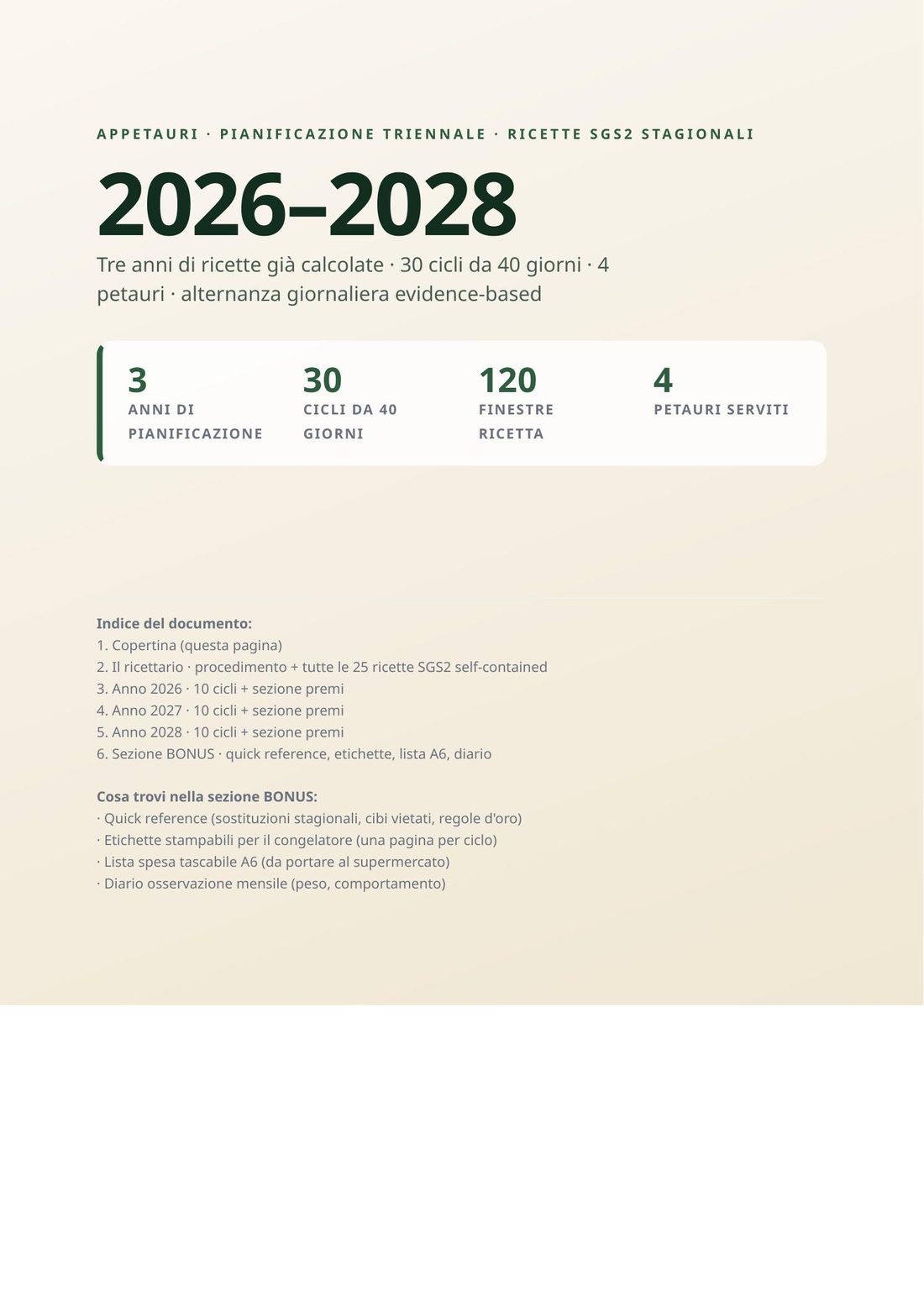
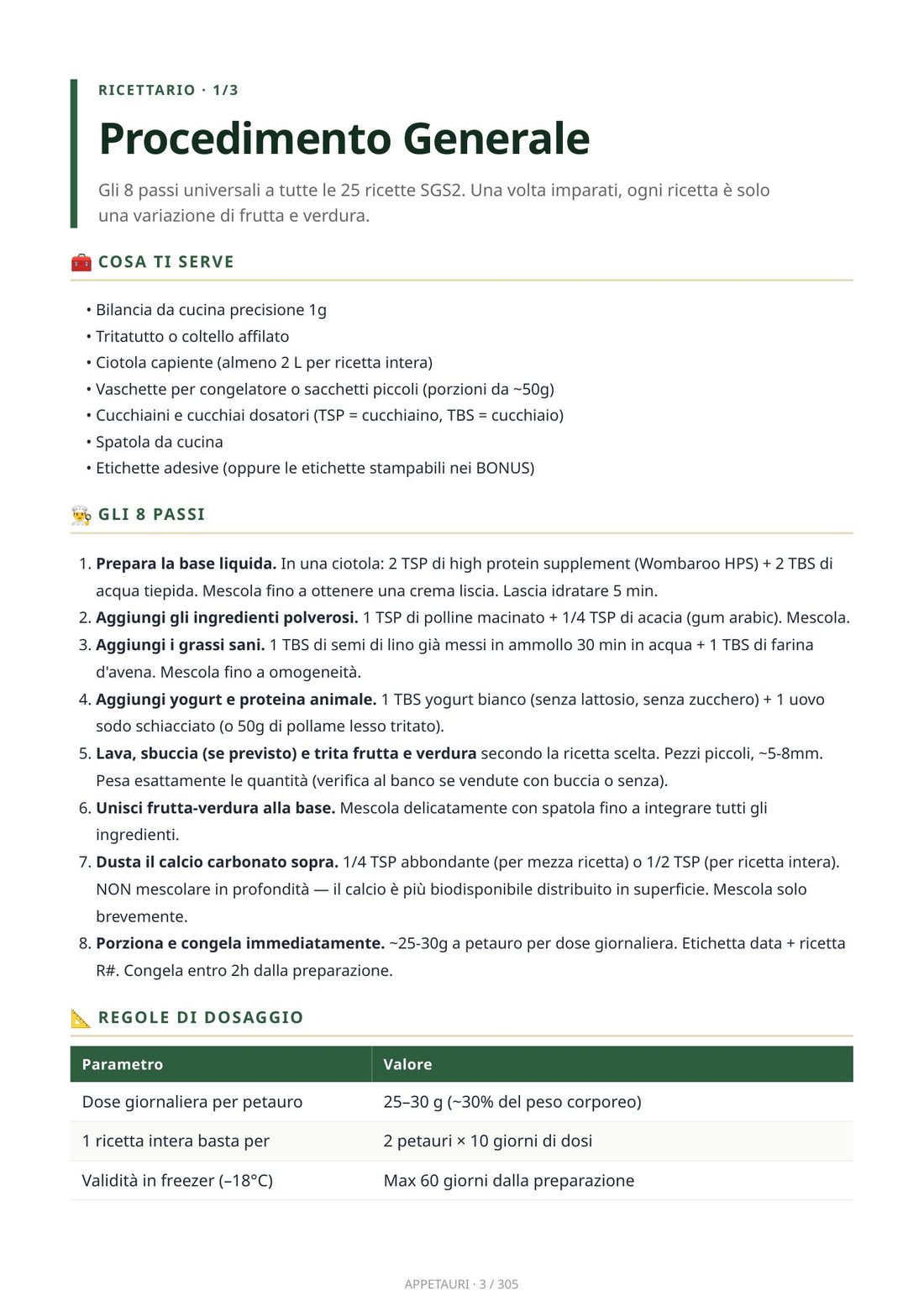
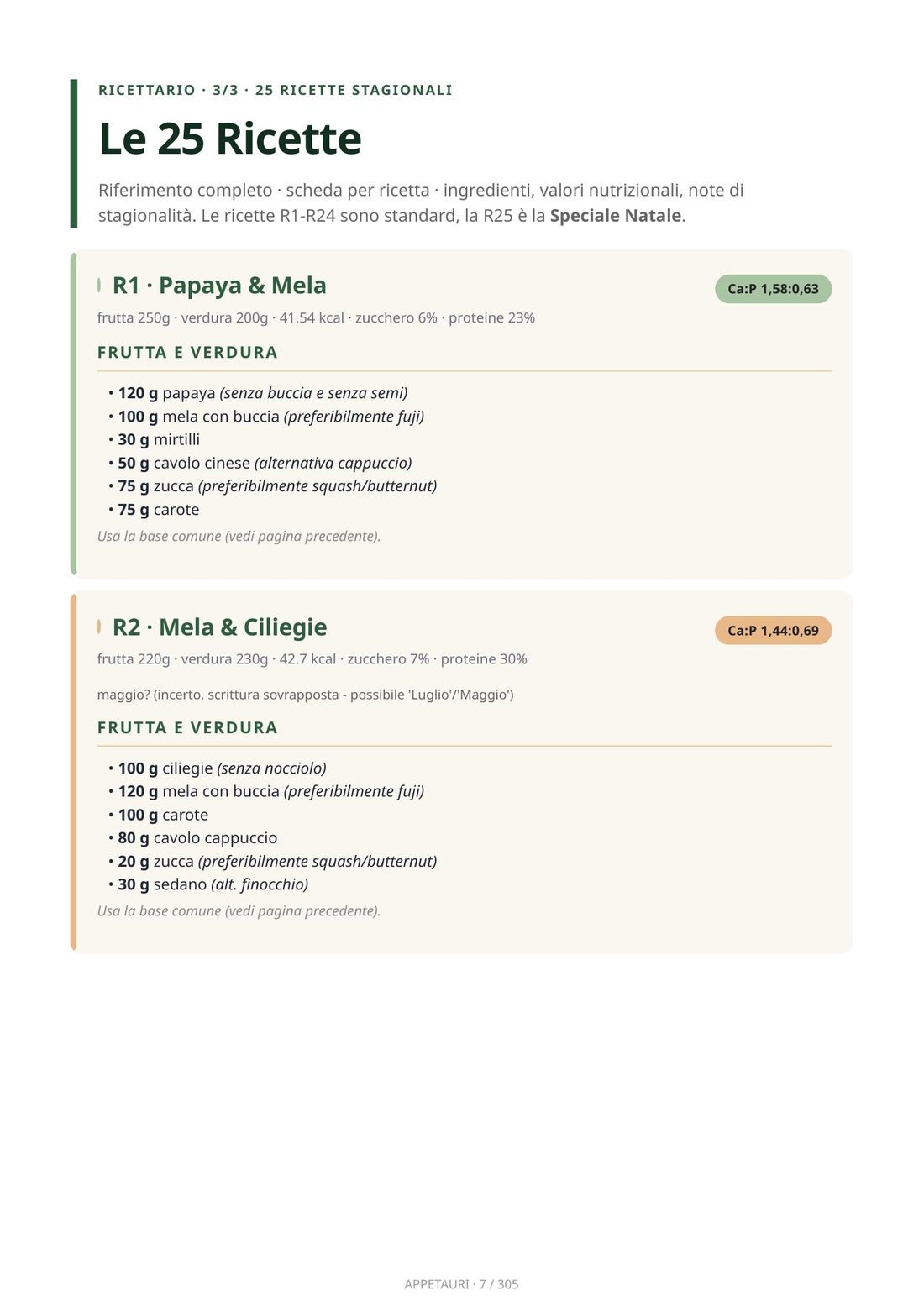
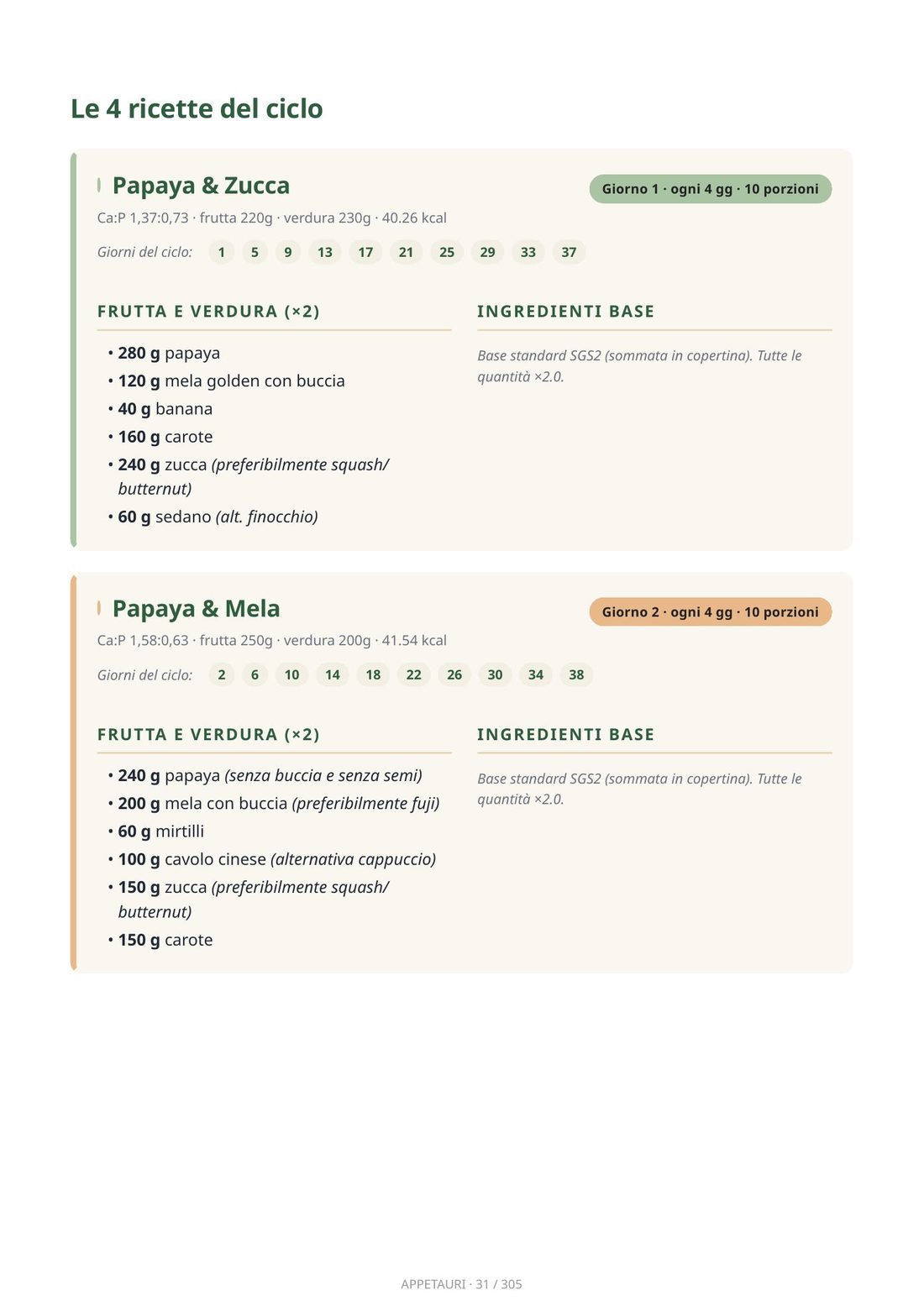

All built into the PDF, ready to print only when you need it.
🎨 How to read the colour grid
The 4 recipes rotate day by day inside the 40-day cycle:
- R1 · thaw this on days 1, 5, 9, 13, 17, 21, 25, 29, 33, 37
- R2 · days 2, 6, 10, 14, 18, 22, 26, 30, 34, 38
- R3 · days 3, 7, 11, 15, 19, 23, 27, 31, 35, 39
- R4 · days 4, 8, 12, 16, 20, 24, 28, 32, 36, 40
At a glance: check the date on the calendar → see what colour it is → thaw the matching box. No mental math.
Why rotate instead of giving each recipe for 10 days straight? Explained below in Science.
Science · why APPETAURI is built this way
The choices below are not opinions. They're grounded in the veterinary and biological literature on Petaurus breviceps. Every paragraph cites its source.
Why we rotate recipes every day (not in 10-day blocks)
Sugar gliders (Petaurus breviceps) in the wild eat eucalyptus sap, acacia gum, pollen, nectar, manna and arthropods — an intake that varies day by day with season and plant they forage on [1,2]. Captive diets should respect the same daily-variety logic, because rotation preserves the gut microbiota signature typical of xylophagous/exudivorous animals adapted to variable inputs [3]. Feeding the same recipe for 10 days straight, then switching, is a distortion driven only by prep/freezing convenience: APPETAURI solves the problem by separating the two — you prep every 40 days, but thaw with daily rotation.
Ca:P 2:1 is the line between health and MBD
Metabolic bone disease (MBD / secondary nutritional hyperparathyroidism) is the leading cause of hindlimb paresis and spontaneous fractures in pet sugar gliders [4]. It's driven by two common errors: (1) inverted Ca:P from insect-heavy diets — mealworms and crickets start at roughly 1:8 against calcium unless gut-loaded before feeding [5,6]; (2) protein excess, since sugar gliders have the lowest documented nitrogen maintenance requirement of any marsupial [7]. The literature target is roughly 1% Ca, 0.5% P, 1,500 IU/kg vitamin D3 on dry basis [8,9,10]. You can only hit this balance with formulated supplements (Wombaroo HPS, HPW, TPG, BML), not improvised fruit and insects.
The absolute no-go list
Some foods are dangerous not because of quantity but because of mechanism:
- Chocolate — theobromine, neurotoxic
- Onion, garlic, leek, chives — thiosulphates that damage red blood cells (Heinz anaemia)
- Avocado (skin and pit) — persin
- Raw milk and dairy — lactose intolerance
- Cured meats and raw aged meat
- Fruit seeds and pits (apple, cherry, apricot, peach) — cyanogenic glycosides
- Unwashed pesticide-treated fruit and vegetables
Sources: Merck Veterinary Manual [8], LafeberVet [9].
There isn't one "sugar glider": there are three
A 2021 taxonomic revision split what was thought to be Petaurus breviceps into three distinct species: P. breviceps, P. notatus and P. ariel [11]. Furthermore the pet stock bred in the USA (and thus most of what circulates in Europe through descent) genetically derives from Western Papuan populations, not from the South-Eastern Australian populations where the classic wild-diet studies were done [12]. APPETAURI states this explicitly: quantities are calibrated for the common pet species but not presented as "universal" for wild Australian gliders.
Out-of-pouch joeys: the critical window
Marsupial maternal milk shifts through three distinct phases: the late phase has more than double the lipids of the early phase [13]. The only validated replacement formulas are Wombaroo Impact + Sugar Glider Milk Replacer [14]. Paediatric MBD shows up as hindlimb paresis between weeks 8 and 14 out of the pouch, typically when the mother herself is calcium-deficient during lactation [15]. For breeders, knowing this means intervening before fractures.
Honest about the product's limits
APPETAURI is a meal plan based on Marie Bannister's SGS2 cookbook and the currently most-cited vet guidelines. It doesn't replace a veterinary visit, doesn't address specific clinical cases (problem pregnancies, struggling-weaning joeys, established MBD), and doesn't guarantee outcomes for those who don't respect quantities or introduce foods outside the list. UVB/D3 calibration for pet sugar gliders in indoor environments is still an open area [16]: if your home is particularly dark or you're unsure about supplementation, talk to an exotic vet.
Cited sources
- Smith, A.P. (1982). Diet and Feeding Strategies of the Marsupial Sugar Glider in Temperate Australia. Journal of Animal Ecology. doi:10.2307/4316
- Suckling, G.C. (1984). Population Ecology of the Sugar Glider, Petaurus breviceps. Australian Wildlife Research. doi:10.1071/WR9840049
- Solden, L., Dierenfeld, E.S., Wrighton, K. (2015). Effect of dietary soluble fiber on gut microbiota in the sugar glider — pilot study. AZA Nutrition Advisory Group. nagonline.net
- Brice, L. & Lecu, A. (2019). Sugar Gliders: Husbandry and Common Diseases. University of Liège. orbi.uliege.be
- Finke, M.D. (2015). Complete nutrient content of four species of commercially available feeder insects. Zoo Biology. doi:10.1002/zoo.21246
- Latney, L.V. et al. (2017). Effects of various diets on the calcium and phosphorus composition of mealworms and superworms. AJVR. doi:10.2460/ajvr.78.2.178
- Smith, A.P. & Green, S.W. (1987). Nitrogen Requirements of the Sugar Glider. Physiological Zoology. doi:10.1086/physzool.60.1.30158630
- Pollock, C. Overview of Sugar Gliders. Merck Veterinary Manual. merckvetmanual.com
- Pollock, C. (2018). Care of the Pet Sugar Glider. LafeberVet (PDF). lafeber.com
- Wombaroo Food Products (2025). Sugar Glider Feeding Guidelines. wombaroo.com.au
- Cremona, T. et al. (2021). Integrative taxonomic investigation of Petaurus breviceps reveals three distinct species. Zoological Journal of the Linnean Society. doi:10.1093/zoolinnean/zlaa060
- Campbell, C.D. et al. (2019). The origin of exotic pet sugar gliders kept in the USA. PeerJ. doi:10.7717/peerj.6180
- Johnson-Delaney, C.A. (2014). Captive Marsupial Nutrition. Veterinary Clinics: Exotic Animal Practice. doi:10.1016/j.cvex.2014.05.001
- Hume, I.D. (1999). Marsupial Nutrition. Cambridge University Press. worldcat.org
- Lennox, A.M. & Bauck, L. (2024). Sugar Glider Pediatrics. Vet Clinics: Exotic Animal Practice. doi:10.1016/j.cvex.2023.10.001
- Watson, M.K. & Mitchell, M.A. (2014). Vitamin D and UVB Radiation Considerations for Exotic Animals. J Exot Pet Med. doi:10.1053/j.jepm.2014.07.007
How it works
No forms, no account, no waiting. Three steps and you're set.
You buy APPETAURI
One-off €19, secure Stripe payment. Card, Apple Pay, Google Pay. You receive a confirmation email immediately.
You download the pack
A single ZIP with all 6 colony-size versions of the guide. Each version is one PDF 2026-2028 with all the bonuses included.
You open your family's folder
3 gliders? Open 3_petauri/. 5? Open 5_petauri/. Inside, the navigable 3-year PDF, ready to print. If your colony grows, the PDF is already there.
It's made for you if…
One payment. Three years of meal plans.
If you did it by hand, it would cost 9-10 half-evenings a year. With APPETAURI, zero.
- FULL RECIPE BOOK · 25 SGS2 recipes self-contained
- Step-by-step method (8 universal steps)
- 3-year plan 2026-2028
- 30 forty-day cycles × 4 seasonal recipes
- All 6 colony-size variants (1, 2, 3, 4, 5, 6 gliders)
- Colour-coded calendar + per-cycle shopping list + recipes
- BONUS · printable freezer labels
- BONUS · pocket A6 shopping list
- BONUS · monthly observation journal
- BONUS · quick reference card
- Science section with cited veterinary sources
- Instant download · 14-day refund policy
Secure Stripe checkout · Card, Apple Pay, Google Pay · VAT receipt included
Frequently asked questions
How long does one batch last?
Each batch produces about 40 days of food (4 recipes × ~10 days of frozen portions each). The PDF is structured by forty-day cycle to match seasonality, so you cook every ~5-6 weeks — not every 30 days.
Does it work for any colony size?
The pack includes all versions for colonies from 1 to 6 gliders. The shopping list quantities are already scaled. If your colony grows, the PDF is already there — no extra purchase needed.
Do I need to already own the SGS2 cookbook?
No: the PDF includes all 25 recipes in self-contained format (one card per recipe with ingredients, common base or recipe-specific overrides, nutritional values, seasonality notes) + the step-by-step preparation method (8 universal steps) + units-of-measure table + where to buy specialty products like Wombaroo HPS, ground bee pollen, acacia (gum arabic), calcium carbonate + magnesium. Everything you need to cook is inside this PDF.
Which cookbook is it based on?
SGS2 (Sugar Glider Soup 2) by Marie Bannister, London-based breeder since 2003 — 24 standard seasonal recipes plus the Christmas Special. All 25 recipes are included in the PDF with precise quantities and method.
What do I get after payment?
Right after payment you get a Stripe email with the download link for the ZIP. Inside you find a folder per colony size (1_petauri/, 2_petauri/ … 6_petauri/): open yours. Each contains a single 2026-2028 PDF with all bonus pack pages included.
Does it work mid-year?
Yes. The PDF covers 3 full years: start from the current cycle. Dates are indicative, and once you finish the third year the same sequence stays valid for the following years. The recipes come from the SGS2 book, written in the UK: some fruit may be out of season where you live in the month your cycle falls. The substitutions page tells you what to buy instead.
What are the "bonus" items included?
4 printable tools inside the same PDF: freezer labels (one per dose, with colour + date + recipe name), pocket A6 shopping list (grocery-store format), monthly observation journal (weekly weights + observations), quick reference (seasonal substitutions, forbidden foods, golden rules). All ready, already scaled to your colony.
Can I print it?
Yes, the PDF is A4 optimised for home printing. The colour-coded calendar grid needs a colour printer to be readable at a glance.
What if I'm not satisfied?
14-day refund policy: email davixspain@gmail.com with your Stripe receipt and I'll refund without questions. EU Consumer Code right of withdrawal (D.Lgs. 206/2005).
Does it replace a vet's advice?
No. The information represents general guidance and does not replace the advice of a veterinarian or a sugar glider nutrition specialist.